

In the video above, Motley shows that puppies are more than capable to eating a diet of proper raw meaty bones (RMB). He is establishing the perfect microbiome in the process.
For some time now the impact that diet has on the microbiome has been known. More and more, we are starting to understand the effects that the microbiome has on health.
The entire community of microbes living in the gut influences not only digestion, but immunity, brain function and thus emotions and behaviour. In recent weeks, I have been coming across some ideas that I have no doubt are well-intentioned, but without the understanding of the importance of the ancestral diet, means that results are being interpreted in ways that aren’t sound. No doubt there will be some people for whom this idea that what you feed your pet has wider implications than just proteins, fats, carbs and micronutrients will be a whole new revelation, so let’s start by explaining some basics.
What is the gut microbiome?
The gut microbiome is the vast community of bacteria, fungi, and other microbes that live inside the digestive tract. It is said that the total body microbiome accounts for 90% of all cells we consider to be an individual. That includes the skin, mouth, respiratory and urinary tract etc of course too, plus other microbes found in other organs including the brain. The microbiome in the digestive tract is a major part of the overall microbiome. A diverse, balanced microbiome has evolved as a symbiotic relationship – one where all parties gain from it. Some elements of the gut microbiome help with food breakdown and nutrient absorption, others support the immune system, and together according to Terrain Theory they protect against those elements which in overgrowth can be pathogenic from replicating out of control and causing disease. Diet is the number one biggest factor shaping this microbial ecosystem.
Just as it is important to recognise that the correct species-appropriate diet is the one the ancestors ate as they evolved, so that diet will have established the parallel optimum microbiome that was established at the same time. The optimum microbiome therefore has a finite diversity and composition. It is human hubris and arrogance to consider that we can “improve” on it in any way, and yet there are some who think that more is always better, and unfortunately advise accordingly. Let’s examine now how perhaps they’ve jumped to this wrong conclusion….
Species Diversity: A Sign of Gut Resilience
Firstly, we need to recognise that pretty well all research done in the pet carnivore realm of nutrition lumps all manner of raw and meat-based diets in together regardless of how much bone, offal, processed treats, veggies and fruit etc are included. I am not aware of any study performed where a pure raw meaty bones diet without plant inclusions has been performed. However, in dogs fed a predominantly raw meat and bones diet, they consistently show greater microbial diversity in their gut compared to those on kibble. Greater diversity is typically a good thing. It means a wider range of bacteria capable of supporting health.
The situation however isn’t a case that raw fed dogs have the same species of bacteria plus additional ones, the mix and balance of species is very different as set out below.
Whilst there may be 500+ detectable species in total, 2/3 of the biome of raw-fed dogs are restricted to just under 40 different species which are predominantly…
Fusobacterium (a genus common in carnivores)
Clostridium hiranonis (supports bile acid metabolism)
Bacteroides and Lactobacillus
Kibble-fed dogs, on the other hand, have less diversity and 2/3 of their biome is only accounted for by about 30 different species which are predominantly…
Prevotella (carbohydrate fermenters)
Enterobacteriaceae (which can include opportunistic pathogens)
Streptococcus and Proteobacteria
From the above it is clear that the diet determines the types of microbes because of fundamentally different composition of the two diets in terms of proteins, fats, carbs and micronutrients etc. In general, it is no surprise that raw diets favour bacteria adapted to breaking down proteins and fats as we find with the microbiome of wolves, whereas kibble diets encourage the dominance of carbohydrate-loving microbes due to high starch and fibre content.
We shouldn’t be surprised that dogs on a raw diet tend to have gut profiles more aligned with their evolutionary background as carnivores. Kibble-fed dogs often show microbial imbalances (dysbiosis), particularly when there’s excessive starch or poor-quality ingredients.
The Misinterpretation
There is an idea circulating that there is a “honeymoon” period where dogs swapped to a raw diet from kibble get an initial increase in diversity, followed by a reduction, supposedly to the point where kibble fed dogs exhibit greater diversity. That the narrative has already been established that diversity is better, I am more than suspicious that this result has been set up to justify feeding kibble on an ongoing basis. This research was reportedly carried out by Dr Nicholas Cage, although I was unable to find the study on PubMed. A quote of his has been used in promotional material for Purina in the past which makes me highly suspicious of conflicting interests, although to be fair, I read another article in which he rightly debunked the myth that grain-free diets increase heart disease.
This idea is being used to justify the inclusion of plant material, especially fermented plants, because there was a correlation with increased fibre and increased microbiome, although correlation does not necessarily indicate causation. Wild carnivores do not collect and ferment plants to eat – it’s ridiculous. So to suggest that this is therefore necessary demonstrates a complete lack of understanding about the diet dogs ate whilst they evolved and the implications for that.
This honeymoon period idea makes no sense to me. I suspect what happens is that swapping from kibble to raw increases diversity because there’s still in many cases a sufficient carbohydrate content in the new “raw” diets due to plant inclusion that slows the reduction in those species of bacteria prevalent in kibble-fed dogs whilst the new raw meat inclusion increases the Fusobacterium species etc that dominate in raw fed dogs. Consequently, the overall diversity increases with this overlap effect.
Following this diversification, with the ongoing largely mixed food ingredients (meat and plant), the digestive system is compromised because there are different requirements for the stomach and gut environment when digesting meat/bone compared with plant ingredients. The dog proverbially falls between 2 stools (the sit on type!!). Maybe the stomach increases HCl acid production to try to compensate for the pH-neutralising effect of the veggies/fruit and this acidity is carried on through into the small intestine and starts to reduce bacterial diversity as a result? Maybe if the veggies/fruit are being supplied raw rather than highly processed plant ingredients as happens with kibble, then the plant-induced bacteria cannot survive so well and reduce in numbers and species? It could be a combination of these and other factors potentially. It’s unlikely to be just one cause.
The most important aspect of the microbiome from my perspective is the quality of the composition of the gut microbiome first and foremost. The closer the biome composition is to the wolf, given that domestic dogs are a subspecies of the grey wolf, the better. What’s the advantage of increased diversity if the additional species don’t contribute to the symbiotic relationship and likely inhibit the beneficial ones, or even interfere with the digestive process/absorption?
Bacterial Load: Numbers Don't Tell the Whole Story
In other words, what I’m saying is that although kibble-fed dogs may have a higher total bacterial load, it is not necessarily increased by healthier bacteria. Similarly, raw diets including plant carbs will still promote the presence and survival of fermentative species that can create excess gas, soft stools, and inflammation. I can see no other way how a raw meaty bones fed dog without plant ingredients can possibly ferment sufficiently to cause a gastric torsion/dilatation which will be fatal if not caught in time, and yet I have heard of “raw fed” dogs dying from it.
Raw-fed dogs generally have a lower total bacterial count, but with a higher proportion of beneficial, carnivore-adapted microbes. Some raw diets (especially those that are pre-ground) risk temporarily introducing transient bacteria like Salmonella or Campylobacter, but these rarely cause illness in healthy dogs with robust microbiomes. I would posit that the inclusion of plant matter and fibre in the diet, and now at higher inclusion levels, will also increase this risk.
Consequently, those who say they promote raw but support a regular and significant proportion of the diet to be veggies/fruit (as opposed to the odd scrap of cooked veggie leftovers from their owner’s meals) then they risk undermining the very diet they supposedly support, because if raw feeding were ever to be banned in future it will be because of the perceived danger to the public from the type of bacteria (Salmonella, E.coli etc) which should be killed first by the strongest stomach acid in the unfortunate event that there might be some bacterial contamination of the dog’s lump of raw meaty bones.
We can also see how diet affects the digestive tract and function from top to bottom, where the local microbiome at each stage will also play a role in oral health in the mouth and flatulence at t’other end! In both cases, the smell would not be viable in the wild if the dog was trying to hunt prey.
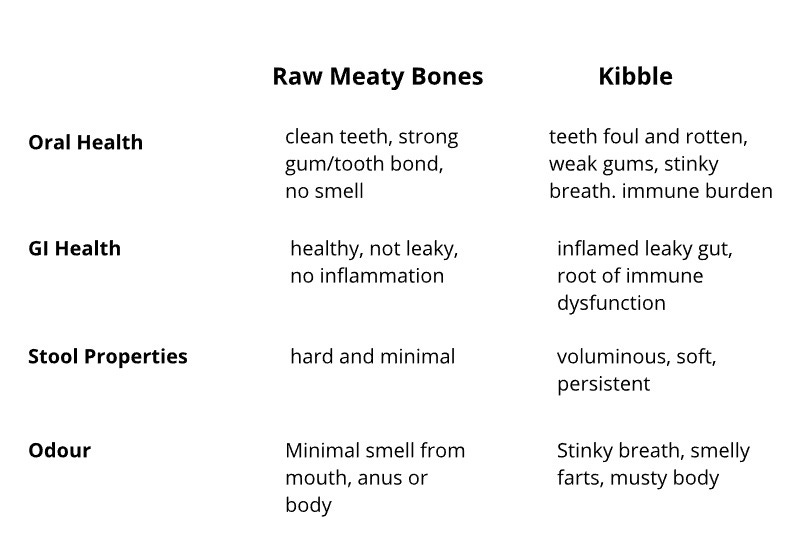
As my good friend and veterinary colleague, Tom Lonsdale, points out if there is periodontal disease and mouth odour to any degree (not just stinky breath) then this will inhibit smell to the point where prey will not be detected until much closer when downwind, or the prey will have much earlier warning that a predator is approaching upwind. Any diet that promotes this is by definition not species-appropriate.
Final Thoughts
The ancestral diet and its associated microbiome don’t lie. A raw meaty bones diet brings dogs closer to their ancestral norms, supporting the optimum diversity and composition of microbial population that are symbiotic to increase digestion, absorption and resilience to digestive upsets.
When our goal is optimal gut health, natural immunity, no emanating smell and firmer stools that don’t create a persistent park hazard, the microbiome points clearly toward feeding a fresh, species-appropriate raw meaty bones diet to our pet carnivores. Although, this is written primarily from the perspective of feeding dogs, the same is true of cats although I think they are subjected to fewer veggies/fruit on the whole.
References
Kim, J., An, J.U., Kim, W., Lee, S., & Cho, S. (2017). Differences in the gut microbiota of dogs (Canis lupus familiaris) fed a natural diet or a commercial feed revealed by the Illumina MiSeq platform. Gut Pathogens, 9:68. https://doi.org/10.1186/s13099-017-0218-5
Sandri, M., Dal Monego, S., Conte, G., Sgorlon, S., & Stefanon, B. (2017). Raw meat-based diet influences faecal microbiome and end products of fermentation in healthy dogs. BMC Veterinary Research, 13(1), 65. https://doi.org/10.1186/s12917-017-0981-z
Schmitz, S., & Suchodolski, J.S. (2016). Understanding the canine intestinal microbiota and its modification by pro-, pre- and synbiotics – what is the evidence? Veterinary Medicine and Science, 2(2), 71–94. https://doi.org/10.1002/vms3.17


